Does Design Really Impact Bar Experiences?
Many of the design choices in bars are obvious. These include the color schemes and the size of the bar, which are easy to judge at first glance. But while customers may be able to zero in on these aspects, they are often unaware of the mechanics that have been designed to tap into their psychology, and thus their experiences. So, which are these, and just how do they impact your willingness to leave or stay?
The Bar Counter
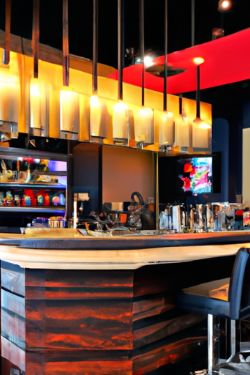
You may think of the bar counter as the place you head to for a small chat with the bartender as you grab your next set of drinks. But it is actually more than that. In fact, some bar interior designers would go as far as saying that the bar counter is singlehandedly the most important structure in the bar. While this might seem like hyperbole, it starts to make sense when you pay attention to its dimensions.
- The height. Did you know that most bar counters are 42 inches high? This height is not by mistake and is instead calculated to suit both the person sitting on a barstool and the person who is standing next to the counter. The person sipping on their drink gets to have a level surface to lean on as they engage in banter, while the person standing can easily also lean on the counter while making conversation with other guests and the bartender. So, the act of ordering drinks or striking up conversations feels less like a transaction and more like a social interaction, which is exactly why people go to bars.
- The depth. Ever noticed that most bar counters are quite deep? We are talking about 20 to 30 inches deep, plus an overhang. Again, this begs the question – why? The bar counter is a bridge between the service area and the sociable environment of the bar. So, if the counter is narrow, these worlds start to feel less divided, and the experience of ordering and paying for drinks starts feeling a tad salesy. But add an overhang and widen the countertop, and guests suddenly have this buffer zone, which they can use to place their drinks, lean over, and even place their phones. They get to enjoy personal space, which makes them feel more comfortable, such that they barely notice the service area.
On top of the dimensions, bar designers also rely on the careful selection of materials when designing countertops. Where bars want a fast environment with lots of high energy, they go for colder materials like marble or stainless steel. But when they want their guests to feel like they are welcome to stay and make conversation for hours, they use warmer materials such as wood and leather on the countertop and surrounding seats. Guests may not be aware of this, but the simple art of touching these materials sends a message to their brains, and this influences their subsequent decisions.
The Seating
Beyond the countertop, bar designers pay a lot of attention to the seating. That’s because where you sit and what you sit on play a very big role in how you feel and how you contribute to the energy in the bar. Let’s consider the most common options you will come across and why designers use them:
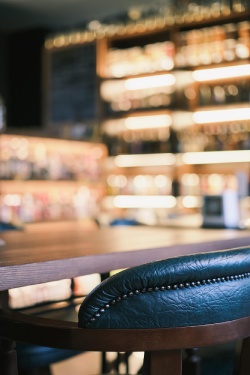
- The swivel stool. These stools are mainstays for the flexibility they offer to guests. One minute, you can be leaning into a private conversation with your friend and the next, you can swivel around to enjoy the buzz in the bar. It’s quite unlike fixed seating, which forces you to go out of your way if you want to turn your attention to anything else.
- The perch. Guests who are waiting for a table, waiting for a friend, or just grabbing one drink before leaving are often near the entrance. But you will notice that most bars do not provide seating here and instead offer high ledges, which guests can lean on as they wait. So, why keep them standing instead of giving them stools or other seats? Well, it turns out that having guests by the door creates this busy vibe that makes a bar look exciting to people who are on the street. After all, people follow the hype and will gravitate towards a bar that seems busy compared to one that does not seem to be getting much traffic.
- The banquette. Most bars do not offer booths to their guests. The idea here is to do away with the whole private island effect that you see in restaurants and instead encourage people to interact with each other. So, they add banquettes in their spaces, which are these long, continuous benches. While guests still get to sit next to their parties and have private conversations, the use of these long benches creates this unified feeling such that anyone on the bench feels like they are part of the scene, even if they never talk to other people in the room.
The energy created by these seating options flows throughout the bar, making the guests feel more connected.
The Sightlines
In a bar, sightlines are not just about what you can see. Instead, they also extend to who can see you. How so?
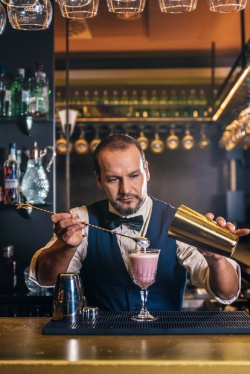
- The bartender. If you pay attention, you will notice that bartenders are often on a lower standing point. While it may not seem evident, as the height difference is often slight, it has a huge effect. From this position, bartenders become the focal point, and guests find themselves focused on what the bartender is doing, which is why they will often put on a show when making cocktails. It becomes a lot like a stage, and guests become the audience. Now, here is where the psychology comes into play - The more that guests watch these preparations, the less they feel the need to entertain themselves, which takes the pressure off themselves.
- The mirror. Many people use the mirrors behind the bar to make sure they are looking the part. But designers do not install these mirrors with this goal in mind. They do it to create a subtle wall where guests who are facing the bar can have a good look at the rest of the room without having to turn around. So, introverts, people who are sitting alone, and people who are contemplating asking someone to dance can use these mirrors to check out the room without feeling exposed. And it also helps people tap into the energy in the room.
So, the next time you are curious about where to sit or stand to take in all the action, you now know where to grab a seat and why.
The Movement
Anyone who has ever been to a crowded bar on a busy night can attest to how hard it can be to reach the bar or the washroom without brushing up against tens of strangers. Do designers know about this? Yes, they do, as it is all part of the layout. Here is how this works:
- The golden path design. When bar designers are creating the layout, they use a concept that focuses on wide arteries for the staff and narrow veins for the guests. So, how does this work? The staff get to have several roomy options to navigate the room, while guests have limited options. You find that as a guest, you pretty much have to interact with other guests to reach the bathroom, order a drink, or even get to the dance floor. And this requires you and the other guests to accommodate each other, be it through turning to the side to allow someone to pass or even verbally expressing your need for room. These small interactions are intentional as they create a buzz in the bar.
- The restroom and bar path. In most bars, you find that you have to pass near the bar on your way to the washroom. But have you ever thought about why this is the case? Besides encouraging interactions with other guests, the need to pass by the bar also pushes you to order more drinks. Again, this ties to the sightlines in the previous point. With the bartender positioned in a way that ensures that guests can see the preparation of the cocktails, you are likely to desire another drink on your way back from the washroom. Interestingly, bar designers also use this path as a way to encourage guests to stay longer in the bar. If a guest is about to clear their tab after coming from the washroom, they are likely to see a new drink and order it. And this keeps them in a cycle.
These design choices are so subtle that it is quite easy to miss them and mistake them for pure coincidence.
The Spacing
Bar layouts determine how big or small these spaces feel, and designers achieve this in two ways. First, we have the choice of materials. Just like they do with countertops, they select materials which influence the environment, a key idea in Bar Culture. For example, when they want to encourage people to lean in towards each other, they use hard surfaces such as tile and glass, as these reflect sound and make it hard for people to hear each other. So, guests find themselves getting much closer to each other so as to communicate. Again, this feeds into the buzz created by the micro interactions. Secondly, designers pinch space in the areas where they want people to come together. Take the example of the space between the bar and the closest tables. Often, you will find that this space is so small that people have no option but to be close to each other. This proximity makes the bar feel quite full even when it is not, and it creates the illusion of being busy.
Quick Links
Gentlemen's club [M]
— 🅾️yd 🅱️awgentte (@lloyd_agt) March 3, 2025
Elemental | Tonberry | Mist W5 P44
I always wanted to create a luxurious bar with billiards inside. Pretty happy with the result! ✨️#ff14housing #hgxiv pic.twitter.com/8rVLjjjfci
With the kind support: