Mastering Bar Lingo
Bar lingo looks different for each group, be it between staff members, guests, or staff members and guests. As such, every minute, a non-verbal conversation takes place between the people in the bar. And whether you know it or not, your body language is constantly communicating with the people around you. That said, let’s delve into the top bar lingo around the world.
The Bartender Read
Did you know that bartenders are trained to read people from the minute they walk into the bar up until the minute they approach the counter? This analysis helps bartenders know exactly how to respond to each guest. How so?
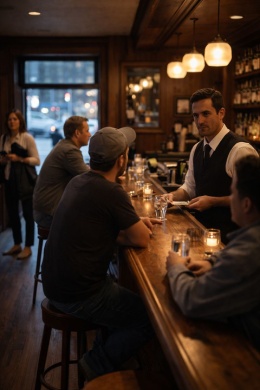
- The initial approach. If someone walks up to the bar with their card or wallet out, the bartender immediately clocks this person as being ready to order drinks. In this case, the bartender rises to the occasion and keeps things moving. But if someone lingers by the door or near the bar as they scan the room, the bartender realizes that this person is not here for a drink per se. Instead, they could be waiting for someone, reading the vibe, or even just listening to the music. As such, the bartender knows not to approach the person, as this would be veering on disturbance.
- The body language. People need different things when they walk up to the bar, and it’s up to the bartender to read their cues and determine how much interaction a person needs. The person who walks over with tight and hunched shoulders likely needs a way to decompress. In such a situation, the bartender understands that this person needs space and is thus likely to play it cool by silently acknowledging them and handing them water or a menu. But if someone walks over with open and relaxed shoulders, the bartender figures that this person is open to having a conversation, and some banter is okay.
- The lean. People tend to lean in or back when talking to bartenders. If someone leans back during the conversation, this indicates that they have no room for much conversation and already know what they want. But if they lean in, they prompt the bartender to also lean in because the guest may be sharing a secret or asking for a recommendation, which they may not want to make public.
Bartenders also know how to clock trouble from a mile away. By judging the behavior of their guests, they can decide who has had enough to drink, who needs to cool down, and who may need to be separated from other guests. And they know how to call in reinforcement if necessary.
The Shared Gestures
With loud music playing, communicating through speaking often proves to be difficult. This challenge is especially greater between guests and the staff because of the distances between them. For this reason, the guests and staff communicate with each other through gestures. Below are the most common ones and their meanings:
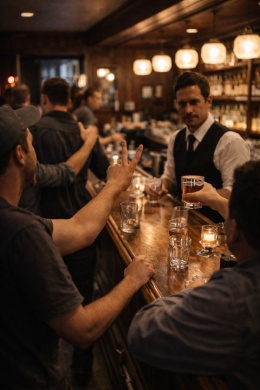
- Flashing two fingers. If you flash two fingers to the staff, you communicate that you either need two more of these drinks or want them to make your drink a double. And when the staff flash two fingers your way, they are letting you know that they see you and will be with you in two minutes.
- Pointing at the glass. If you want a refill or the same drink as you have just had, you can point to your glass when making eye contact with the server. In the same way, if the server or bartender is unsure of the drink size that you ordered, they can hold up a glass and point to it. This way, if you nod yes, they know they are right. And if you shake your head, they can go through other glass sizes until they get confirmation from your end.
- Tapping on the shoulder. The staff work in crowded and noisy bars, and this comes with the risk of bumping into each other and spilling drinks. So, as they move across the room, you may notice that they often lay a flat palm on each other’s backs. This is their way of letting their colleagues know that they are behind them with glasses or drinks and that their colleagues should stand in place.
- Lifting the glass. There are two reasons why you may want to raise your glass to the staff. First, you may want to share a silent ‘cheers’ with them, which you can do when the glass is still full. Secondly, you may want another drink. So, instead of pointing to your glass, you can lift it up, and the staff will get the cue.
- Writing in the air. Once you are ready to leave, you can signal the staff to bring your check by writing in the air. Or you can simply make the check signal, which looks just like the ‘right’ symbol. Alternatively, some people mouth the word ‘check.’
Knowing these gestures can make your time in the bar much more comfortable as you can communicate with the staff without ever leaving your spot.
The Eye Contact
The saying goes that the eyes are the windows to the soul. And in bars, these same eyes serve as vital communication tools through glances. How so?
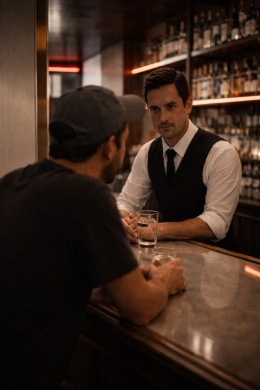
- The acknowledgement. When you walk up to the bar, you may notice that the bartender makes a point of glancing your way. This simple act, no matter how hurried, is their way of saying that they see you and will get to your order. But if you do not make eye contact or look away too soon, you signal to them that you are not ready to order. So, the next time you stop by the counter, make sure to linger with eye contact as this affirms your intent to place an order and gets you in the queue.
- The gaze. Bartenders must understand how to read social dynamics to avoid interrupting deep conversations, which may be flirting or even business meetings. But how do they know? We will share a trick that you, too, can also use to gauge the right moment to interact with people. Whenever people are engrossed in a conversation, they look at the other person’s one eye, the other eye, and then their mouth. When bartenders see that they are making this triangular gaze, they know that an interruption would not be welcome, and so they bid their time until the moment is right. Try doing this the next time you need to interrupt people and see just how well it works.
Overall, bartenders do not fix their eyes on one person, and instead, they allow their eyes to roam the room in search of empty glasses, raised hands, or other gestures we covered before. However, there are cases where they fixate on people because they have sensed trouble and want to assess the situation before acting.
The Ghost Signals
While people often communicate directly with each other in bars, they also rely on cues to send messages to each other. Here are some of the ways that these may show up in interactions:
- The service speed. Bartenders are generally open to conversations, but this depends on their workload. When they are not dealing with a large number of orders, they take their time with the drinks and will set down your drink slowly before you, while making eye contact. But when they are dealing with an influx, they communicate this by not slowing down. They barely make eye contact and get into this flow state where they are making and serving drinks, which is their way of saying that they are in survival mode and have no time to chat.
- The tilted stool. If someone wants to reserve a seat for another guest, they will tilt the other person’s stool. It communicates that the seat is taken and the other guest is somewhere in the bar or on their way. People see the tilt and walk past the stool because they understand what this means.
- The coaster capping. Bartenders and servers are in the habit of clearing glasses immediately after guests leave their seats. But sometimes, you may want to use the washroom or go out for a smoke even if you are not done with your drink. In this case, you can place your coaster on top of the glass. It lets the bartender and other servers know that you are coming back and that they should not clear your drink.
- The coat on the seat. You can easily claim a seat by hanging your coat over it. Not only does this allow you to leave your seat and come back to find it empty, but it also establishes a long-term relationship with the bartender and the servers. They see the coat and know that you are here to stay and are not just grabbing a drink and leaving.
- The phone face up or down. People rely on external cues to determine if they can approach you. If you do not want people approaching you, leaving your phone face up works because it lets the world know that you are busy waiting for a text or call from people outside the bar. It is essentially a boundary. But if you place your phone face down, you communicate that you are open to interacting with other people in the bar, including the bartender.
- The closed circle. As much as bars are public spaces where people interact freely, there are times when people want to have a private conversation, so they huddle in a group with their backs to other people. If you see this, it means that the conversation is only meant for the people in that circle. But if they stand in a ‘v’ shape and angle their bodies to face the room, they are inviting other people to be part of their discussion.
Knowing what signals you are sending to other people can help you make choices that either set boundaries or invite other people to interact with you.
Quick Links
Gentlemen's club [M]
— 🅾️yd 🅱️awgentte (@lloyd_agt) March 3, 2025
Elemental | Tonberry | Mist W5 P44
I always wanted to create a luxurious bar with billiards inside. Pretty happy with the result! ✨️#ff14housing #hgxiv pic.twitter.com/8rVLjjjfci
With the kind support: